


ClubGG Poker
NSUS Ltd
ClubGG Poker is a free card game from NSUS Ltd that puts the emphasis on playing poker with other people rather than treating the table as a purely solo challenge. I found its appeal easiest to understand when I approached it as a social poker app: the value comes from having a group to play with, a reason to return, and enough comfort with poker rules to enjoy the decisions instead of fighting the interface.
The game is aimed at Teen users, and it has been available since October 22, 2020. It currently appears as version 26.05.0229 and requires Android 6.0 or later. On the store, it has passed 500 thousand installs, with an average rating of 3.2 from around 2.6 thousand ratings and 243 written reviews. Those numbers suggest a real audience, but also a mixed experience, so I would not recommend installing it blindly. The important question is whether you want a club-style poker environment and already have people, tables, or routines that make that format worthwhile.
What the first sessions feel like
My first useful goal in ClubGG Poker was not to chase a grand reward or force myself into long sessions. It was simply to understand how the app turns a familiar poker hand into a social activity. That distinction matters. Many card games give you a clear solo ladder, a campaign map, or a stream of unlocks. Here, the early motivation feels more connected to finding your place at the table and learning how the club experience fits your habits.
That makes the opening less dramatic than a traditional progression game. You are not necessarily pulled forward by a story or a sequence of increasingly elaborate boards. Instead, the early goals are practical: become comfortable with the table, make decisions without hesitation, and work out whether playing with friends is enough of a reason to keep returning. For a poker player, that can be satisfying. For someone expecting a heavily structured card adventure, it may feel under-directed.
I would give yourself a few short sessions before deciding whether it suits you. The first session is often spent reading the layout and judging the pace of hands. The second is more revealing because you can focus on your choices rather than basic orientation. If you are playing with friends, the social context can make this learning period feel natural. If you are alone and hoping for a strong sequence of solo objectives, the experience may seem thinner than alternatives built around missions.
Related News

Threads in Real Life: Who Should Join, Lurk, or Leave

How SHEIN Turned Shopping Into an Endless Content Feed

How to Make Fortnite Feel Smarter on Mobile

Should You Switch to Microsoft Outlook on Mobile?

Why Gallery Keeps Pulling Users Back

X Review: Why Its Network Still Matters
One practical tip is to treat the opening as a test of table comfort, not as a race to prove your poker ability. Pay attention to how quickly you can follow the action, how easy it is to recognize whose turn it is, and whether the rhythm leaves enough time for thoughtful decisions. Those details decide whether an app like this becomes a regular meeting place or an icon you stop opening.
Progress is easier to notice through play than through spectacle
ClubGG Poker does not need a complicated presentation to make a hand meaningful, but that also means its progress signals are less obvious than in games with loud level-ups and constant reward screens. I noticed improvement in smaller ways: I became quicker at reading the table, more deliberate about when to stay involved, and better at separating a bad result from a bad decision.
That is a genuine form of progression, although it is mostly player-driven. The app can provide the setting, but your sense of advancement depends on what you want from poker. If your goal is to become more comfortable playing socially, repeated sessions can show clear progress. You learn the flow, recognize familiar patterns, and stop wasting attention on the controls. If your goal is a visible collection of unlocks, ranks, or cosmetic milestones, the experience may not provide the same constant feedback as a more game-like card app.
Gallery
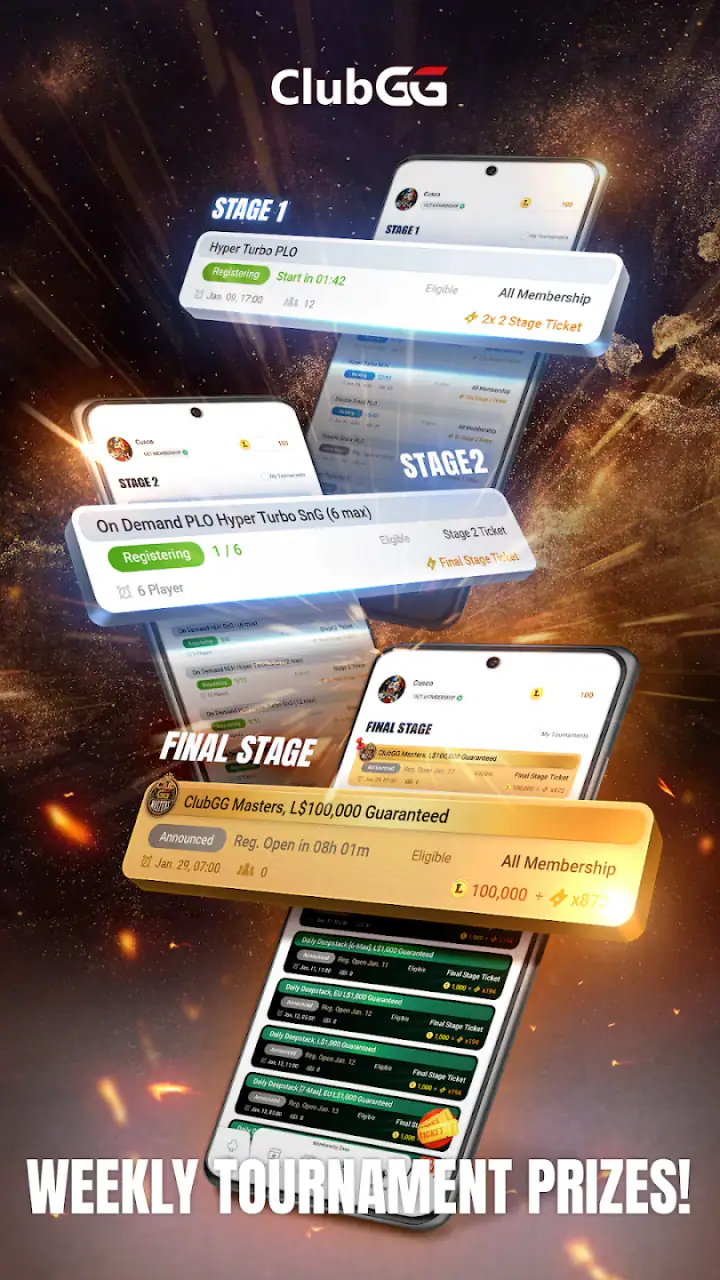
This is where the “play with friends” idea becomes more than a short slogan. A regular group creates its own progress markers. You may remember a close hand, notice that a cautious player changed tactics, or improve at managing a session without making every decision emotionally. Those moments are not flashy, but they give the game continuity. The table becomes a shared routine rather than a disposable match.
I also found that progress can be measured by the quality of your decisions instead of the amount you win. Poker naturally produces misleading results: a sensible choice can lose, and a poor choice can succeed. If you judge every session only by the outcome, the pacing can feel unfair and your motivation may swing sharply. A better approach is to review a few memorable hands afterward and ask whether the choice made sense with the information available at the time. That habit gives the app more depth than simply tapping through hands.
For new players, I recommend setting a narrow learning target for each session. You might focus on avoiding rushed calls, observing how other players act before your turn, or leaving when concentration drops. This is a concrete way to create progression even when the game is not presenting a long chain of explicit objectives.
Challenge comes from people, not a scripted difficulty curve
The difficulty curve in ClubGG Poker is different from the one found in a puzzle card game. There is no reason to expect every stage to become harder in a neat, predictable sequence. The challenge changes with the people at the table, their experience, their patience, and how seriously they approach each hand. That makes the game less controlled but potentially more replayable.
A beginner can understand the basic idea of making poker decisions fairly quickly, yet that does not mean the game becomes easy. The difficult part is judging incomplete information while resisting the urge to react to one lucky or unlucky hand. More experienced players can create a much steeper challenge than a tutorial opponent because they punish predictable behavior and make you think about timing, not just the strength of your cards.
This human difficulty curve is a strength when you want a social contest. It is a weakness when you want a carefully balanced solo experience. In a conventional poker game against computer opponents, you can often choose a difficulty level and expect a relatively stable challenge. In ClubGG Poker, the table itself is the difficulty setting. That creates memorable sessions, but it can also produce uneven evenings where the game feels relaxed one moment and demanding the next.
My advice is to avoid treating every table as a test you must pass. If the pace or skill level is uncomfortable, the problem may be the match rather than your ability. Poker is especially vulnerable to frustration because losing several hands can make players change their style for emotional reasons. Taking a break is not a failure of progression; it is part of keeping the game enjoyable.
Another useful trade-off is between conversation and concentration. A friendly table can make the experience warmer, but social distractions can also cause rushed decisions. When I wanted to play thoughtfully, I treated the table as a focused activity. When I wanted a casual evening with friends, I accepted that the poker would be less precise. ClubGG Poker works for both moods, but the player has to choose the balance.
Retention works best when the group supplies the reason to return
The strongest reason to come back is the presence of people you actually want to play with. That sounds obvious, but it changes how I judge the app. A social poker game does not need to manufacture urgency if your friends already create a regular occasion. The return loop can be as simple as checking in for another session, remembering the previous table, and seeing whether your decisions hold up against familiar opponents.
The weaker side of that design is that the app may lose some of its pull when the social connection is missing. A player looking for a self-contained daily routine could prefer a poker app with clearer missions, a campaign, or an explicit ladder. Those systems give you a reason to play even when nobody you know is available. ClubGG Poker is more dependent on context: the same game can feel engaging with a group and ordinary without one.
Because in-app purchases range from $0.99 to $999.99 per item, I would approach the monetization carefully. The free entry makes it easy to try the core experience, but the wide purchase range is a reminder to decide on a personal spending boundary before getting invested. I would not treat purchases as proof of progress or as a substitute for better poker decisions. If the social experience is not enjoyable without spending, spending more is unlikely to solve the underlying problem.
This is especially important for younger players because the content rating is Teen. I would keep purchases under deliberate control and avoid making quick decisions during a losing or frustrating session. A simple rule works well: never buy anything while trying to recover from a disappointing result. Step away, decide later, and ask whether the purchase improves the way you play with friends or merely extends a temporary mood.
For an everyday use case, imagine a small group that cannot meet in person but wants a relaxed poker evening. ClubGG Poker can serve as the shared table while everyone chats elsewhere or focuses on the hands. The best routine would be to agree on a start and end time, keep the session short enough to remain social, and avoid turning every result into a judgment of skill. That structure protects the fun and prevents the app from becoming an endless, distracted scroll.
Where it stands beside familiar poker alternatives
Compared with a solo poker game, ClubGG Poker is more appealing when human interaction is the main objective. A solo alternative is usually better for learning at your own speed, testing rules privately, or filling a few minutes without coordinating with anyone. It can also offer a more predictable difficulty curve. ClubGG Poker wins when the table itself is the content and the people around it matter.
Compared with a casino-style poker app focused on rapid anonymous matches, the club framing suggests a more personal kind of session. That can make the game feel less disposable, particularly when you return to the same group. The trade-off is that the experience may feel less immediately rewarding if you want a constant stream of opponents and obvious short-term objectives.
Compared with a collectible card game, the differences are even clearer. Collectible games usually build long-term motivation through decks, card acquisition, upgrades, and carefully staged challenges. ClubGG Poker asks you to find interest in decisions at the table rather than in building an expanding collection. If you enjoy optimizing a deck, unlocking new abilities, or following a campaign, another card game will probably provide a stronger progression structure.
I would also choose a conventional free poker trainer over this app if my main aim were to learn fundamentals without social pressure. A trainer can let you pause, repeat situations, and concentrate on one concept. ClubGG Poker is better once you want to apply your judgment in a living table environment, where timing, uncertainty, and other players’ habits all affect the experience.
Small habits that make the pacing more enjoyable
The first habit I recommend is using shorter sessions while you are still learning the table rhythm. Long sessions can make every hand blur together, especially if you are checking the app casually between other activities. A defined stopping point makes it easier to remember what you learned and prevents tired decisions from becoming your main impression of the game.
The second is to separate social success from poker success. A session can be worthwhile even if your results are poor, provided the table was enjoyable and your decisions were improving. Conversely, winning does not automatically mean the session was well played. Keeping those two judgments separate reduces the pressure that can make a casual game feel like work.
The third is to watch for your own retention pressure. If you find yourself reopening the game because you are curious about the next hand, that is healthy engagement. If you are returning mainly because you feel compelled to recover a loss, catch up with others, or justify an earlier purchase, the pacing has stopped working for you. At that point, a break or a different type of card game is the better choice.
Finally, use the social format deliberately. Invite people who enjoy the same pace, agree on whether the session is casual or competitive, and do not assume that every friend wants the same level of focus. This is a non-obvious strength of ClubGG Poker: the experience can be shaped by the group. It is also a limitation, because the app cannot repair a poor match between players.
My verdict on goals, challenge, and staying power
I see ClubGG Poker as a focused social card game rather than a broad progression adventure. Its early goals are about becoming comfortable at the table, its progress signals come from improving judgment and building a shared routine, and its difficulty curve is created by the people you play against. That design can sustain play for a long time when you have a reliable group, but it is less convincing for someone who needs constant unlocks or a clearly scripted path.
The free price makes trying it straightforward, while the Teen rating and the range of optional purchase prices mean I would approach it with sensible spending limits. The mixed 3.2 average rating also fits my overall impression: the app has a clear purpose, but that purpose will not appeal equally to every poker player. It is not trying to be a solo campaign, a collectible card battler, and a quick arcade game at the same time.
I would recommend it to friends who want a dedicated place for social poker and who are comfortable creating their own goals. I would skip it if I wanted a rich single-player progression system, a carefully staged difficulty ladder, or a game that remains equally engaging without other players. Its best feature is the shared table, and its biggest weakness is how much the experience depends on having the right people there.
In the end, ClubGG Poker earns its place on my device when I treat it as a reason to meet and play, not as an endless reward machine. If that is what you are looking for, the app offers a straightforward way to build a recurring poker habit. If you need the game itself to provide every goal, unlock, and motivation, a more structured card alternative will be a better fit.
FAQs for ClubGG Poker
What is ClubGG Poker, and how does it work?
ClubGG Poker is a mobile poker platform focused on private clubs, home-game communities, and organized poker groups. After installing the app, players can usually join a club through an invitation, club ID, or administrator approval, depending on the club’s setup. The app provides poker tables, player profiles, club communication, and game-management tools, but the available features may vary between clubs and regions.
Is ClubGG Poker free to download and play?
ClubGG Poker can generally be downloaded without an upfront purchase, but that does not necessarily mean every game or feature is completely free. Some clubs may organize play using virtual chips, while others may involve separate arrangements managed by club administrators. Before joining, users should carefully review the club’s rules, payment policies, and any applicable fees. Never assume that in-app chips have cash value unless the official terms clearly state so.
Can I play real-money poker on ClubGG Poker?
Whether real-money poker is available depends on the club, local regulations, and the way games are organized. ClubGG Poker may provide the software and club environment, while individual clubs or organizers determine the games they host. Users should check the official terms, age requirements, and laws in their country before participating. Avoid unofficial payment requests, and only use trusted, clearly explained methods approved by the platform or club.
What devices and accounts are compatible with ClubGG Poker?
ClubGG Poker is designed for mobile users and may be available on supported Android and iOS devices, although compatibility can depend on the operating-system version and regional store listing. Players normally need to create or verify an account and maintain a stable internet connection. Performance is best on a reasonably modern phone or tablet with sufficient storage, updated system software, and notifications enabled if they want timely club invitations or game alerts.
Is ClubGG Poker safe and suitable for beginners?
ClubGG Poker can be suitable for beginners who understand basic poker rules and join a reputable, well-moderated club. However, the safety of the overall experience also depends on the club administrators and the people participating in each game. New users should read club rules, protect their login details, avoid sharing personal information, and verify every transaction or invitation. Responsible play is essential, particularly where games involve money or valuable virtual items.
Pros
- Official platform with access to ClubGG’s global poker community.
- Supports popular Texas Hold’em formats and regular online games.
- Private clubs make it easy to play with friends or selected groups.
- Available on both Android and iOS devices.
- In-app events and promotions can add variety to regular play.
Cons
- Real-money features may not be available in every country or region.
- Gameplay depends heavily on a stable internet connection.
- The app may feel overwhelming for beginners learning poker basics.
- Club access and available tables can vary by location and time.
- Poker involves financial risk when playing with real money.


